
The Lake Life Guide · September 26, 2026
How to Tell if Sunglasses Are Polarized: 3 Easy Tests
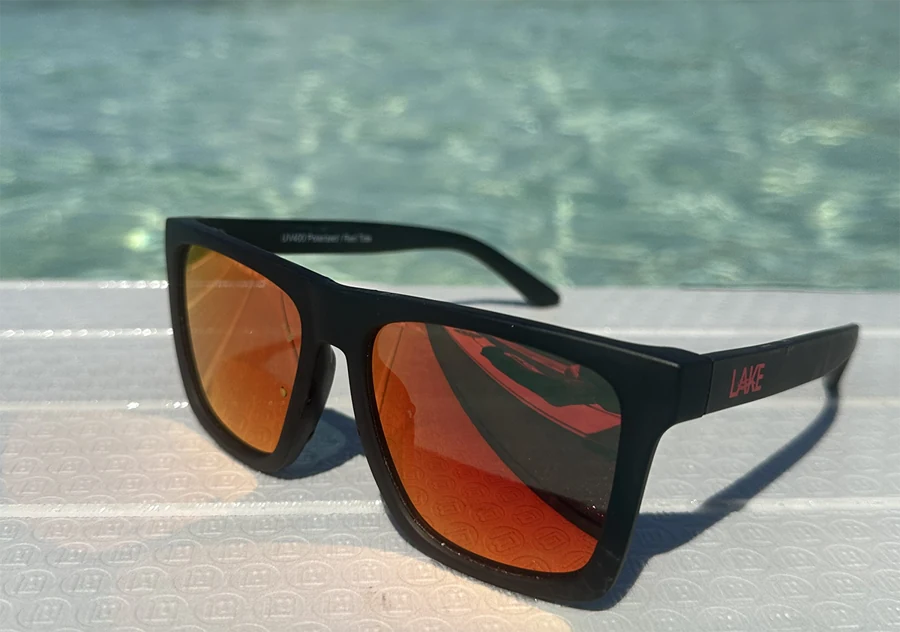
Polarized sunglasses can make a noticeable difference around water, wet roads, windshields, and other reflective surfaces. The challenge is that polarization cannot always be identified by looking at the lens.
A dark lens is not necessarily polarized, and a lighter lens can still contain an effective polarizing filter. If you are unsure about a pair, these three simple tests can help you check.
What Do Polarized Lenses Do?
Light normally travels in many directions. After sunlight reflects from a smooth horizontal surface such as water or pavement, much of that reflected light becomes concentrated in one direction. We see it as glare.
Polarized lenses contain a filter designed to reduce that reflected glare. The American Academy of Ophthalmology compares this filter to a miniature set of blinds that blocks sideways reflected light while allowing useful light to pass through. American Academy of Ophthalmology
That glare reduction is why polarized lenses are especially helpful for fishing, boating, driving, and spending time near the water.
Test 1: Look at a Digital Screen
A phone, tablet, computer monitor, or television can provide a quick polarization test.
-
Turn the screen brightness up.
-
Hold the sunglasses in front of the screen.
-
Look through one lens.
-
Slowly rotate the sunglasses about 90 degrees.
If the screen becomes noticeably darker or nearly black at a particular angle, the lens is probably polarized.
Many LCD screens already use polarizing filters. When the screen’s filter and the sunglass filter cross at certain angles, much of the light is blocked. Ohio State University’s eye health guidance describes this screen rotation method as a simple way to identify a polarized lens. Ohio State Health & Discovery
This test does not work equally well with every device. Screen technology, viewing angle, brightness, and screen protectors can affect the result. Try another screen if the first test is inconclusive.
Test 2: Compare Two Pairs of Polarized Sunglasses
If you have another pair that you know is polarized, you can use the two lenses together.
Hold one pair in front of the other and look through the overlapping lenses. Keep the first pair still while slowly rotating the second pair.
The overlapping area should become much darker as the lenses approach a 90 degree angle. When two polarizing filters are crossed, they block most of the light that would normally pass through them.
If the view remains essentially unchanged while you rotate the second pair, one or both pairs may not be polarized.
Test 3: Check Glare on Water or Another Reflective Surface
This is the most practical test because it shows what polarized sunglasses are designed to do.
Find a safe location with visible reflected glare. Good options include:
-
A lake or pond
-
A wet road or parking lot
-
A vehicle hood
-
A glass tabletop
-
A bright window reflection
Look at the glare through the sunglasses, then slowly tilt your head toward one shoulder. With polarized lenses, the intensity of the reflection should change as the filter angle changes. The glare will usually be weakest when your head is upright and become more visible as you tilt.
Never perform this test while actively driving. Stop in a safe place before comparing glare or adjusting your sunglasses.
Why Does My Phone Look Dark Through Polarized Sunglasses?
A dark or rainbow colored phone screen does not usually mean something is wrong with your sunglasses.
The effect occurs because the phone display and sunglass lenses are filtering light in different directions. Rotating the phone or slightly changing your viewing angle will often make the screen easier to see.
This can also happen with dashboard controls, GPS displays, ATMs, fuel pumps, and some watches. The American Academy of Ophthalmology lists LCD readability as one of the practical limitations of polarized lenses. American Academy of Ophthalmology
Polarization and UV Protection Are Different
These home tests only help identify polarization. They do not confirm UV protection.
Polarization reduces reflected glare. UV protection filters ultraviolet radiation. One feature does not automatically prove the presence of the other.
Look for a label stating that the sunglasses provide UV400 protection or block 99 to 100 percent of UVA and UVB radiation. If you are uncertain, many optical shops can test UV transmission with a photometer. National Eye Institute
Our guide to polarized versus nonpolarized sunglasses explains these differences in greater detail.
Choosing Polarized Sunglasses for Outdoor Use
LAKE’s Austin Black polarized sunglasses feature VistaClear® polarized lens technology designed to reduce glare from water, roads, windshields, and other bright outdoor surfaces.
You can also compare additional frame shapes and lens colors in the complete LAKE polarized sunglasses collection.
The easiest test is the one that matches how you will use your sunglasses. Try a screen indoors, compare two polarized lenses, or check glare near the water. If the brightness changes as the lens rotates, the polarizing filter is doing its job.